
Lumosity vs BrainHQ: Which Brain Training App Actually Earns Your Subscription?
One feels like game night; the other, like a physio session for your neurons. Here's how to pick the one that fits your goals.
Last updated: Oct 16, 2026
Read time: 12 min

Head of Product Marketing at Nibble
You score "faster than 84% of people your age," feel like a genius, then forget why you walked into the kitchen.
The question " Lumosity vs. BrainHQ" is one most people ask right after a small win. Researchers have studied that gap. In 2016, a review of more than 130 brain training studies found that people get better at the games they practice, with little proof the gains carry over.
Lumosity and BrainHQ are subscription brain training apps that use short cognitive tasks to train memory, attention, and processing speed. So which one wins? That depends on your goal, because the two apps chase very different ones. Lumosity leans into fun and variety. BrainHQ leans into clinical research.
Below, you'll get features, prices, research backing, and a clear verdict for each type of person. And if you'd like a lighter way to keep your brain curious between sessions, try Nibble for quick lessons in Logic, History, and trivia games.
Disclaimer: This article is for general information only. Brain training results vary from person to person, and none of the apps mentioned here are medical tools. Nibble is a microlearning and daily growth app, not a treatment for memory loss, ADHD, or cognitive decline. If you're worried about your memory or mood, talk to your doctor.
Quick summary: Lumosity vs BrainHQ at a glance
Short on time? Here's the verdict before the details.
- Lumosity vs BrainHQ comes down to fun variety versus research depth.
- Lumosity offers 50+ colorful games and says it has over 100 million users.
- BrainHQ exercises are referenced in 200+ peer-reviewed papers.
- BrainHQ costs about $14 a month, and Lumosity costs about $12.
- Neither app reliably improves skills far outside the trained tasks.
Both apps work on speed. If you also want to grow what you know, Nibble's Logic lessons and Trivia Quiz fill that side of the plate. Keep reading for the full side-by-side guide.
What Lumosity and BrainHQ are: Two takes on cognitive training
Lumosity is a gamified brain training app made by Lumos Labs, a San Francisco company that launched it in 2005. Its daily workout mixes quick brain games with a Fit Test that shows where you're starting from.
The games sit in groups of cognitive skills: speed, memory, attention, flexibility, problem-solving, language, and math. Lumosity is the household name of brain games, the way Rosetta Stone became shorthand for language apps. Ask a friend to name one brain app, and this is probably it.
BrainHQ is a research-based cognitive training program from Posit Science, a company founded in 2002. Neuroscientist Michael Merzenich, known for his work on brain plasticity, co-founded it. Some people search for it as "brain hq," but it's the same app.
Its exercises fall into six groups: Attention, Brain Speed, Memory, People Skills, Intelligence, and Navigation. The People Skills group has you read social cues like facial expressions, a small slice of everyday communication skills.
Lumosity vs BrainHQ: The side-by-side comparison
| Feature | Lumosity | BrainHQ |
|---|---|---|
| Developer | Lumos Labs (2005) | Posit Science (2002) |
| Training style | Gamified, colorful brain games | Clinical-feel exercises that adjust difficulty |
| Main focus | Variety across many cognitive skills | Processing speed, attention, memory |
| Signature task | Daily workout + Fit Test | Double Decision (useful field of view) |
| Free version | A few free games per day | One free exercise per day |
| Research backing | Smaller body of studies; 2016 FTC settlement over ad claims | 200+ published papers; ACTIVE study lineage |
| Typical monthly price | ~$12 | ~$14 |
| Typical annual price | ~$70 | ~$96 |
| Platforms | iOS, Android, web | iOS, Android, web |
| Best for | Casual users who want a fun way to train | Older adults and evidence-focused users |
Lumosity vs BrainHQ: pick Lumosity for variety and fun, and pick BrainHQ for research depth.
The biggest gap is design philosophy. Lumosity looks and sounds like a mobile game, with bright colors and a score after every round. BrainHQ has a clinical feel that's closer to a vision test at the eye doctor's office.
The second gap is scientific validation. BrainHQ's speed exercises grew out of a long line of university research on aging. Lumosity has studies too, but fewer, and its ad claims once landed it in trouble with regulators.
Why does that matter to you? Lumosity's user interface is designed to be engaging and fun, so it's easy to open on a tired Tuesday night. BrainHQ's interface is functional and less intuitive, and your first few sessions can feel like a puzzle before the real puzzles start. The app you'll actually open every day will usually do more for you than the one with better stats.
🧠 Want to feed your brain new ideas, too? Get the Nibble app and pick up a fresh fact from History, Space, or Psychology in a few minutes a day.
Features: How each brain training software feels day to day
The best way to compare these apps is to look at what using them actually feels like, from the games you play to the feedback you get after each session.
Lumosity features: Short games with a scoreboard
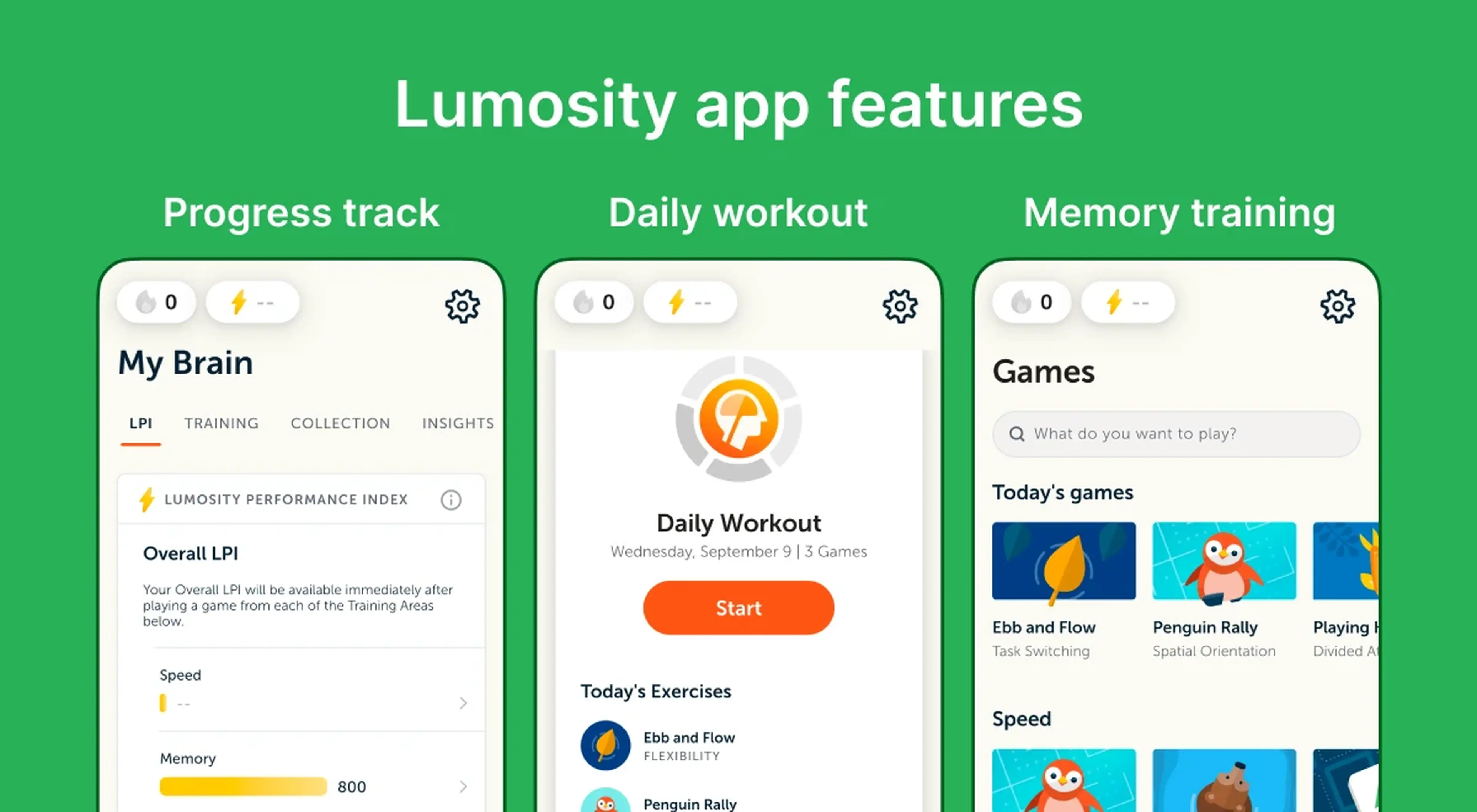
Lumosity is built around quick daily training sessions. Here's what you get:
- A personalized daily workout of about 3–5 games, picked to cover different skills.
- The app tracks your progress with the Lumosity Performance Index (LPI), a score you can compare with players in your age group.
- Speed Match, a game that asks if each card matches the one before it, as fast as you can tap.
- Memory Matrix, a game that flashes a pattern of tiles and asks you to rebuild it.
- Attention games built to boost attention when the screen gets busy.
- Sound effects, streaks, and scores that keep casual users coming back.
A full workout takes about as long as a coffee refill. That's a big reason people stick with it longer than they planned.
BrainHQ features: Exercises that adapt to your reaction time
BrainHQ adjusts difficulty after every single trial. Get it right, and the next round gets harder. Miss, and it eases off a little, so the task stays tough but doable.
Double Decision is BrainHQ's best-known exercise, built to widen your useful field of view. You spot a car in the center of the screen and a sign at the edge, while the display flashes faster and faster. It trains processing speed and reaction time, the skills you use when a cyclist shows up at the corner of your eye.
The Personal Trainer feature picks exercises for you, and progress charts show how your scores move over the weeks. Other exercises work on working memory, like holding a short sequence in mind for a few seconds.
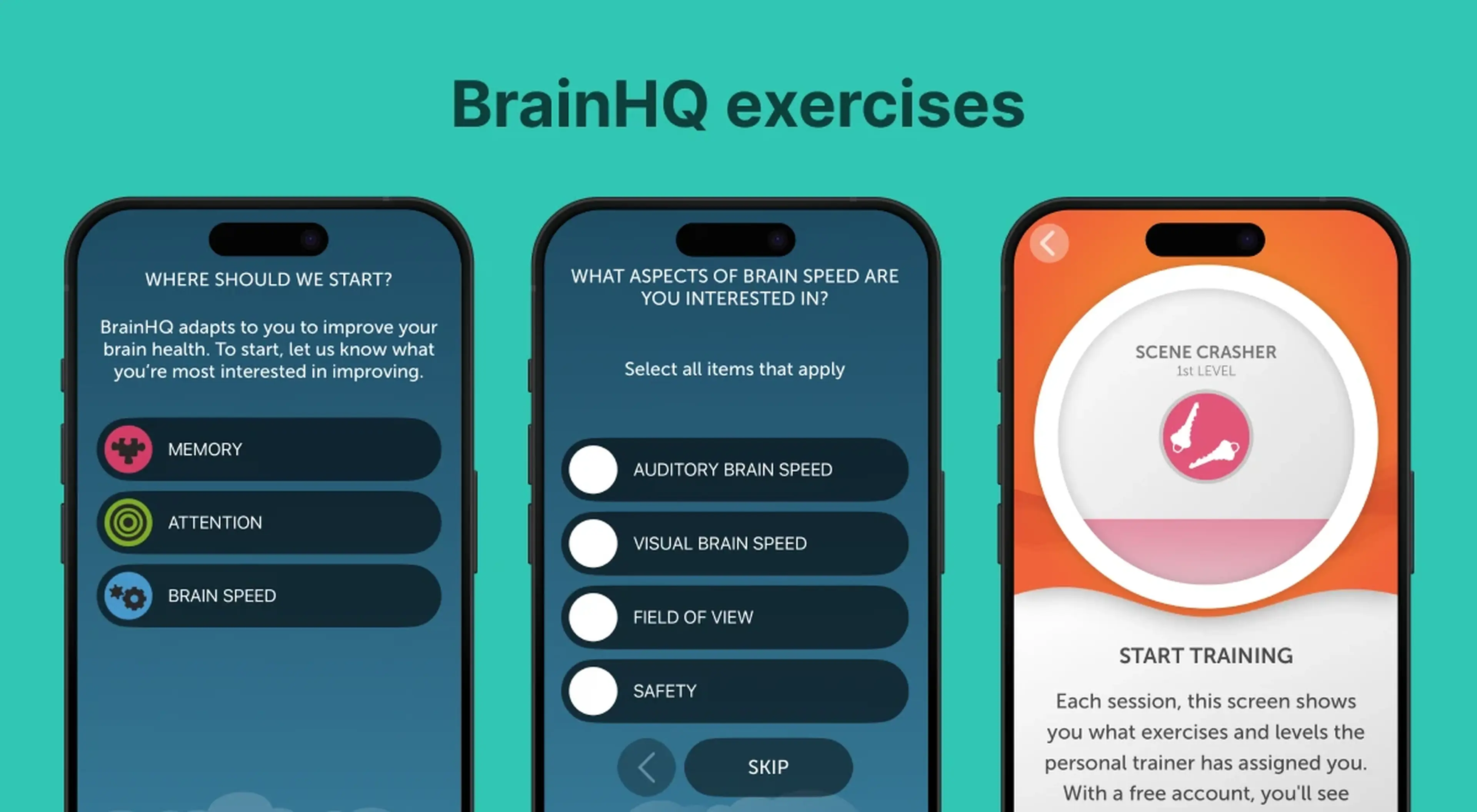
The honest downside? The exercises feel more like tests than games. Screens are plain, rewards are few, and the motivation mostly has to come from you.
The scientific evidence: What research says about each app
The ACTIVE study is a large trial funded by the National Institutes of Health that followed nearly 2,800 older adults for 10 years. Volunteers got one of three kinds of training: memory, reasoning, or speed of processing. That speed training is now part of BrainHQ.
The key findings came out in 2017. People in the speed group had a 29% lower risk of dementia than the control group, and more sessions meant lower risk. Researchers framed it as a way to lower the risk of cognitive decline, and dementia was partly self-reported, which is a real limitation.
Lumosity's record looks different. In 2016, Lumos Labs paid $2 million to settle FTC charges that its ads went beyond the scientific evidence. The ads had suggested the games could improve cognitive performance at work and school and even delay age-related decline. The company said that marketing language had been discontinued.
Here's the part most reviews skip. Researchers sort training gains into three levels:
- You improve on the trained tasks, meaning the actual games you play.
- You get some carry-over to similar tasks, which researchers call near transfer.
- There's limited evidence for far transfer to real-world cognition, like reading comprehension or decision-making at work.
That lines up with the Simons review. Practice makes you better at the game, while the effect on real-world abilities stays thin. The ACTIVE speed results are one reason scientists keep studying the question.
So what does this mean for you? Brain games are like a gym membership for one muscle group. You'll get stronger at that one move, and that's useful, but it won't replace a full fitness plan. Cognitive function in real life also leans on sleep, movement, friends, and how much you know about the world.
Pricing plans: What you'll pay for Lumosity, BrainHQ, and similar apps
Both apps use a subscription model, and both let you try before you pay. The catch is how much the free version actually gives you.
| App | Monthly price | Annual price | Free option |
|---|---|---|---|
| BrainHQ | ~$14 | ~$96 | One free exercise daily |
| Lumosity | ~$12 | ~$70 | Limited daily free games |
| Elevate | ~$10 | ~$50 | Limited free games |
| NeuroNation | ~$8 | ~$55 | Free basic exercises |
| CogniFit | ~$20–30 | Varies by plan | Limited free assessment |
| Peak | ~$7 | ~$35 | Limited free games |
| Nibble | ~$11.99 (intro) | ~$49.99 | 7-day free trial on annual plan |
Prices are approximate as of October 2026 and vary by platform, region, and promos.
On Lumosity, "a few free games" means a short daily set, with most of the library locked. On BrainHQ, you get one free exercise a day. That's enough to feel the style, but it's not a real training program.
BrainHQ also has a family add-on, so a partner or parent can train under the same account for an extra fee. For a full breakdown of Lumosity's plans, see our guide to Lumosity cost.
Is the annual plan worth it? Do the math first. BrainHQ's $96 a year works out to $8 a month, compared with $14 month-to-month. Lumosity's $70 a year comes to under $6 a month.
If you'll use the app most weeks, annual saves real spending money. If you tend to quit apps after a week, start monthly and upgrade later.
Weighing a third option? Elevate is priced around $10 a month or $50 a year, the cheapest annual plan of the three. It also won Apple's App of the Year award in 2014, so its design is about as polished as brain apps get.
That matters if Lumosity feels too arcade-like and BrainHQ feels too clinical, since Elevate's games lean toward reading, writing, and math skills you use at work.
Pros and cons of Lumosity: Where the fun stops paying off
Pros
- Five-minute workouts fit a coffee break or a bus ride.
- With 50+ games, you rarely get the same mix twice in a row.
- Polished design, sounds, and streaks make it a fun way to start a habit.
- The LPI score makes your progress easy to read at a glance.
Cons
- The free tier caps you at a few games a day, and users say the upgrade prompts feel constant.
- Its research backing is thinner than BrainHQ's.
- The 2016 FTC settlement shows its old health claims went too far.
- High scores mostly reflect skill at the games themselves.
Pros and cons of BrainHQ: Where the research pays off
Pros
- It has one of the largest research bases among consumer brain training software.
- It's a strong pick if you want scientifically validated cognitive training on your phone.
- Some Medicare Advantage plans offer it at no extra cost.
- Some healthcare professionals use its exercises in clinical applications, such as research programs for older adults.
Cons
- The plain design looks dated next to Lumosity.
- Exercises can feel repetitive after a few weeks.
- At about $14 a month, it's one of the pricier apps in its category.
Want the full picture? Read our complete BrainHQ review.
🧠 Turn your next coffee break into a quick lesson with the Nibble app, and keep your daily streak going with games like Trivia Quiz and Match the Pairs.
What real users say about Lumosity and BrainHQ after a few weeks
On the App Store and Google Play, Lumosity reviews often praise the games as fun and easy to stick with. The most common complaint is the paywall. People enjoy the free games, then hit a wall when they want more.
BrainHQ reviewers on both stores often say the speed exercises made a difference in daily life, especially reaction time behind the wheel. The flip side shows up just as often. The exercises feel dull, and some people admit it takes willpower to keep going.
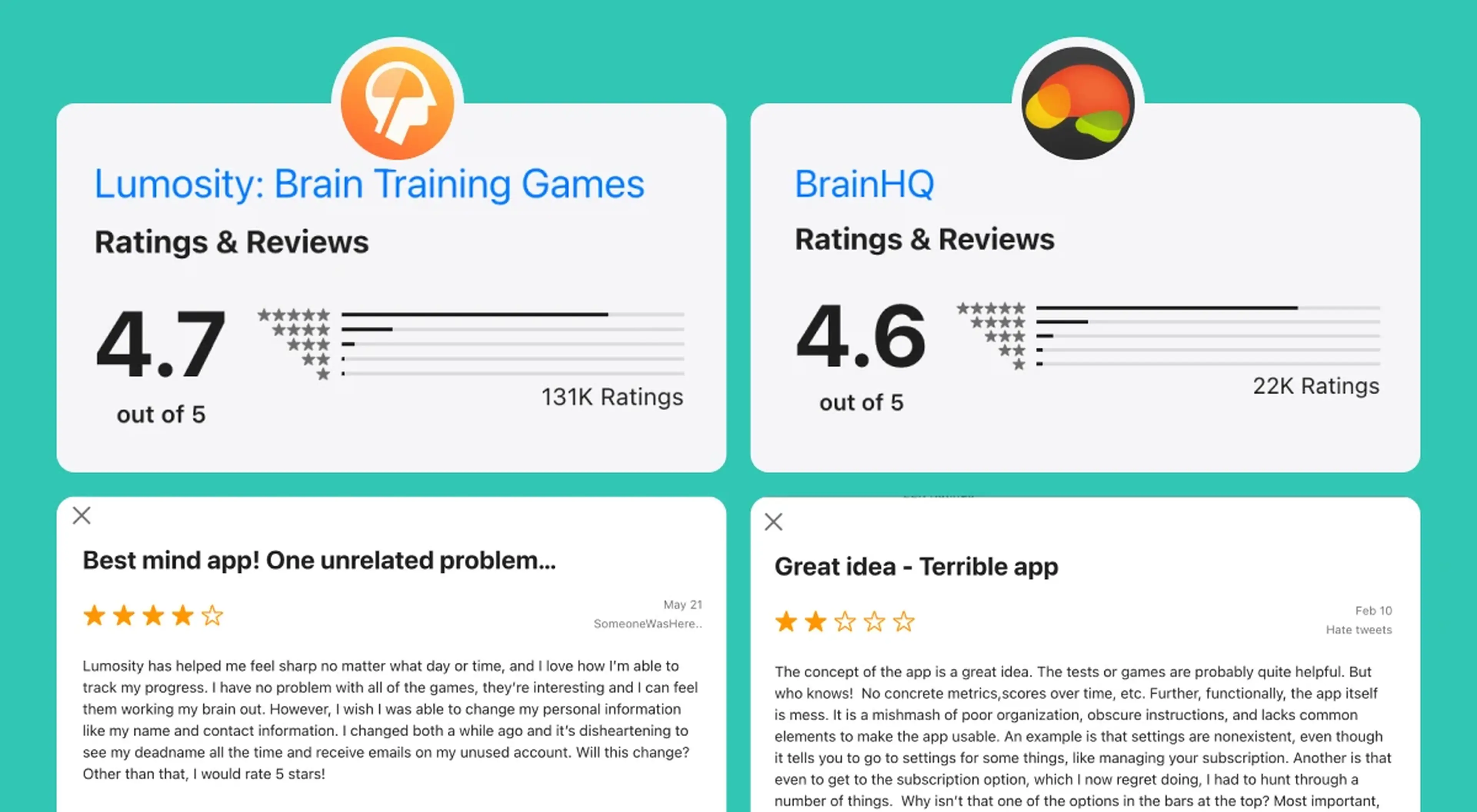
Notice the pattern? People love the app that feels like a game, and they respect the one that feels like homework. In real life, the app that helps most is the one you'll actually open.
Lumosity or BrainHQ: Which one fits your brain health goals
There's no single best brain training app for everyone. Use this quick guide:
- If you're one of the casual users who wants a fun way to boost focus, pick Lumosity.
- If you're an older adult who cares about long-term cognitive health, pick BrainHQ.
- If you want measurable gains in processing speed, pick BrainHQ.
- If you usually quit apps after a week, pick Lumosity, since its variety helps you keep going.
- If you'd rather grow what you know than how fast you react, try a knowledge app like Nibble.
You don't have to commit to one path, either. The sweet spot for many people is 10 minutes of a brain app, plus a few minutes of learning something new.
Still shopping around? Our Peak app review and our Brilliant review cover two more popular picks.
When brain games aren't enough: Building knowledge alongside speed
Brain games train speed on narrow tasks. Building broad knowledge and practicing recall across real subjects trains something else: the stuff you bring to a dinner conversation, a museum visit, or a pub quiz.
Nibble fits in here as a companion to your brain app. Here's what it offers:
- The Logic topic has short lessons on reasoning, spotting logical fallacies, and pattern recognition in everyday situations.
- Trivia Quiz and Match the Pairs are active recall games that make you pull up facts about History, Space, or Psychology.
- Five formats let you read, watch, listen, play, or chat, so the lesson matches your energy that day.
- The AI Tutor lets you chat with historical figures, so you could ask Sigmund Freud what he thought about memory.
Active recall means pulling a fact out of your memory, which sticks better than rereading it. The Logic lessons also give you practical skills, like noticing a weak argument in a headline. That's problem-solving you can use the same day.
Comparing knowledge apps too? See how Nibble stacks up in our SmartyMe app review and our Nibble vs Imprint guide.
Why Nibble fits the gaps in your day
- Personalized content. The For You feed builds a learning path around the interests you pick, and you can change them anytime.
- Daily streaks. Nibble tracks your days in a row, which gives you a light nudge to come back tomorrow.
- 35+ topics. You can jump between Space, Criminology, Art, Personal Finance, and more in one app.
- Games. Complete the Picture, This or That, Trivia Quiz, and Match the Pairs turn review into play.
- Light lessons. Bites run 1.5 to 15 minutes, so a lesson fits the line at the coffee shop.
What Nibble users say about their daily learning habit
Brain apps track scores. Nibble users tend to talk about something else: how their phone time feels now. Here's what a few of them shared.
Bea Faklová, nutritionist: "It awakened my long-sleeping love for studying." She says keeping her streak going helps her push past procrastination. Read Bea's story.
Shae Legan: "I've found a way to start my day with a sense of curiosity." Shae fits short lessons in while brushing her teeth or making breakfast. Read Shae's story.
Richard, a busy dad of two: "Typically, around or just after 7.30, I'm in the living room, open the app, and look at the explore section." He traded his morning Facebook scroll for History and Art. Read Richard's story.
Ela, TV production: "I made a promise to myself to find at least a small moment each day to learn something new." She uses the random breaks between flights and events for Nibble. Read Ela's story.

Want your curiosity to get some reps too
Nibble serves bite-sized lessons for the curious mind
Give your curious brain a daily snack with Nibble
Lumosity vs BrainHQ really comes down to what you want from your 10 minutes. Lumosity gives you variety and fun, and BrainHQ gives you research depth and adaptive speed drills. Both train how fast you think. Nibble feeds what you think about, which makes it a natural next step.
Nibble packs 35+ topics into lessons that run 1.5 to 15 minutes, with a For You feed that suggests what to try next. Streaks and games like Trivia Quiz keep it light. Swap one evening scroll for a 5-minute lesson on why so many ancient statues lost their noses, then a quick trivia round, and your screen time feels a lot better.
Start with the 7-day free trial on the annual plan and see how it fits your day. Download Nibble and give your brain something new to chew on tonight.

FAQs about Lumosity vs BrainHQ
Is BrainHQ covered by Medicare?
Several Medicare Advantage plans offer BrainHQ for free to their elderly clientele. With Original Medicare, on the other hand, the service is not covered. Each plan and state comes with different rules on coverage, and hence it is prudent to either call up the insurer or check out the member benefits page of the plan. In case BrainHQ is part of the chosen plan, you will be provided with a code to activate the complete subscription.
Does Lumosity improve IQ?
There is no sound proof that Lumosity has any effect on raising IQ levels. Players improve in the games they play, but improvement in skills on the game does not equate to enhancement in overall cognitive ability. Researchers refer to this as the transfer problem, as skills acquired through training on one game do not carry over to other unrelated tasks. Some research shows slight cognitive improvement in related tasks; however, big assessments show no long-lasting positive effect on IQ scores.
How many minutes a day should you do brain training?
Several applications recommend around 10-15 minutes a day for a couple of days weekly. Research programs are considered to be more systematic. For instance, in the ACTIVE study, the initial training utilized around 10 hourly sessions done in 5-6 weeks, with some follow-up sessions at a later stage. When it comes to apps, short and regular is often better than long and infrequent.
Is BrainHQ or Lumosity good for ADHD?
Evidence is limited. Both apps let you practice attention tasks, which may help you improve focus inside the games. A few small studies have looked at executive function, the brain skills that handle planning and self-control. Neither app is an approved ADHD treatment, though. If you have ADHD, treat them as a fun extra and keep working with your doctor on a care plan that fits you.
Can brain games help with depressive symptoms?
A handful of studies, including follow-ups from the ACTIVE trial, measured mood and found fewer depressive symptoms in some speed-trained groups. Results are mixed, and the studies weren't designed to treat depression. Brain games may support brain health as one healthy habit among many, but they can't replace therapy or medication. If you're struggling with low mood, please reach out to a doctor or counselor.
Is Lumosity worth paying for?
It depends on how often you'll actually play. If you open it most days and enjoy the games, the annual plan works out to less than $6 a month. If you only play a few times a month, the free games may be plenty. Keep expectations realistic, too. Research supports better game scores far more than broad cognitive benefits in everyday life.
Which is better for memory, Lumosity or BrainHQ?
Both apps target memory with dedicated games, so you'll practice recall either way. BrainHQ has more published research on memory and processing speed, and its Memory exercises adapt to you after every try. Lumosity's memory games feel lighter and more playful. If you want to improve memory with stronger research behind the exercises, BrainHQ is the safer bet of the two.
Are there free alternatives to Lumosity and BrainHQ?
Yes, with limits. Most of the best brain training apps, including Elevate, Peak, and NeuroNation, have free tiers with a few daily games, and Lumosity and BrainHQ do too. If you'd like something that builds knowledge as well as speed, Nibble offers a 7-day free trial on its annual plan, with Logic lessons, trivia games, and short lessons on 35+ topics.
Published: Oct 16, 2026
 128K+ ratings worldwide
Keep your curiosity sparked with Nibble
Join 10M+ people and discover bite-sized ideas across 35+ topics with an all-around knowledge app
