
Replace Scrolling with an Addictive Geography Game: The Smarter Way to Use Your Phone
You pick up your phone for a minute, but often end up scrolling for 20. Sounds familiar? But what if you could replace scrolling with an addictive geography game that grows your brain instead of numbing it?
Last updated: Dec 20, 2025
Read time: 11 min

By Nibble Team
Nibble's Editorial Team
Our editorial team loves exploring how things work and why. We’re guided by the idea that people stay curious throughout their lives — they just need engaging stories and ideas to reignite that curiosity.
With the right mini-game, you can turn a five-minute swipe into a moment of real learning. In this article, we'll show you why you scroll longer than you mean to, why geography games are perfectly tuned to hook your brain in a healthier way, and how the Nibble app helps you swap your scroll habit for exploring the world in bite-sized sessions. Here's how to take back your time without giving up your favorite guilty pleasure of picking up your phone. One tiny switch, and your screen time works for you.
Why endless scrolling sucks and how it hooks you
Infinite scroll is the user-interface design pattern where new content loads continuously as you scroll, with no clear "end" or break. It hooks you by exploiting several psychological mechanisms:
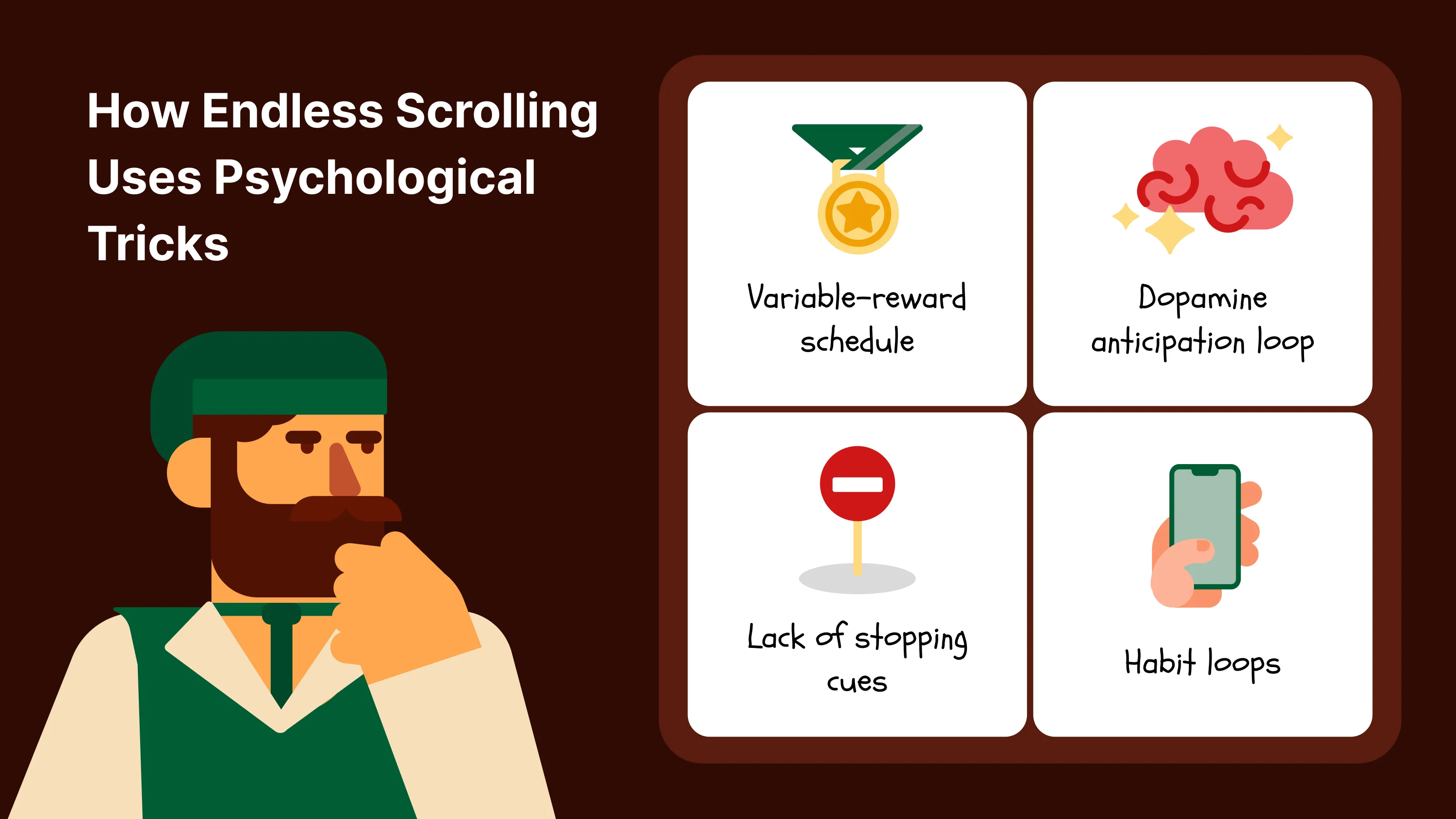
Variable-reward schedule: Platforms mimic the reward patterns found in slot machines. Behavioral psychology shows that unpredictable rewards release more dopamine than predictable ones, making you keep checking "just in case" the next post is better. Dopamine anticipation loop: Each swipe triggers anticipation of novelty. Neuroscience research shows that dopamine spikes before the reward, not after — which means the act of searching — "Maybe this post or video will be great" — keeps you infinitely hooked. Lack of stopping cues: Classic studies in behavioral design show that humans rely on built-in cues, like the end of a page or chapter, to know when to pause. Infinite scroll removes these cues, making it easy to slip into "time loss." Habit loops: According to habit-formation research, repeating a behavior in response to the same trigger, for example, boredom, waiting, notifications, wires the loop deeper. Your phone becomes the default escape before your brain even realizes it.
Effects of endless scrolling
• Significant time loss, often unnoticed until you check your screen-time report. • Fragmented attention, as rapid content switching wears down focus. • Minimal learning, since passive consumption rarely moves information into long-term memory. • Worse mood, with studies linking heavy passive scrolling to higher anxiety and lower well-being.
Many of us scroll endlessly — but instead of pouring minutes into an infinite feed, you can replace scrolling with an addictive game session that satisfies the same craving for novelty while actually giving you progress and closure. In the next section, you'll see why your brain responds so differently to a game than to a feed.
What kind of alternative catches the brain instead of the feed?
Habit research shows that the easiest way to change a routine is to swap it gradually with something that feels similar but healthier. A few minutes at a time is enough to start reshaping the pattern. When you replace scrolling with addictive geography game play, you're making a smarter switch for your attention — and you don't need to do it all at once.
Why your brain responds better to games than to feeds
Two approaches work especially well: micro-learning and game-based learning. Both satisfy the brain's craving for quick stimulation but do it in a more structured, rewarding way. Geography games hit the same craving points because they deliver: • Quick dopamine hits from completing challenges and unlocking correct answers • Novelty through new flags, countries, landmarks, and trivia each round • A sense of progress as your score rises and your knowledge builds • Defined closure, since each session ends, giving you a pause to catch your breath, rather than pulling you into an endless flow
Replacing just a small slice of your screen time with short geography game sessions gives your brain the stimulation it wants, but in a way that leaves you sharper, not foggier — and it's a change you can make slowly, one five-minute switch at a time.
Why geography games (and not just any game) are uniquely powerful
Geography games aren't just a fun alternative to scrolling — they tap into cognitive skills that make them effective for adults who want stimulation without overwhelm. Unlike many casual games, geography games not only train memory and pattern recognition but also deliver quick hits of enjoyment. Here are three reasons geography games beat scrolling:
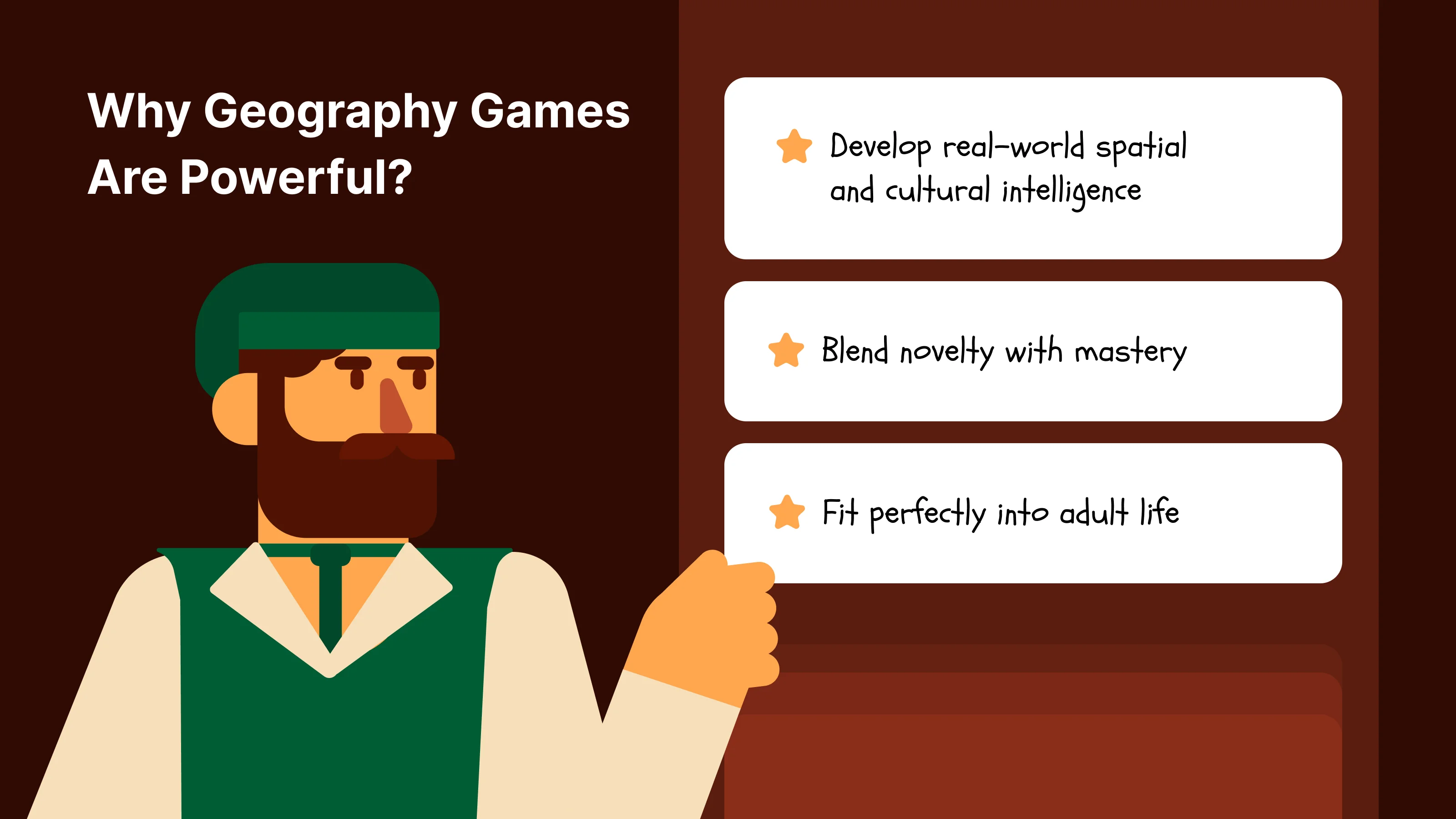
1. They develop real-world spatial and cultural intelligence
Geography games challenge you to interpret maps, symbols, landscapes, and cultural cues, thereby strengthening several cognitive systems simultaneously. GeoGuessr, for example, trains your ability to spot road signs, vegetation types, architectural styles, or even sky color to determine where you are — challenging you to identify the mystery country using critical thinking and visual clues. Seterra and World Geography Games offer geography quizzes with a practice mode that helps you recognize country shapes, capitals, rivers, and flags through repetition paired with gameplay — a method shown to improve long-term recall and boost your geography skills. Every correct guess builds your internal "mental map" of the world, a skill tied to spatial reasoning and global awareness.
2. They blend novelty with mastery
Your brain loves two things at once: Something new, and a feeling of progress. Geography games deliver both. Each round presents a new country, landmark, or trivia clue — while also giving you rising scores, streaks, or levels that show clear growth. Games like Stack the Countries or Travel Mapper combine discovery with unlockable stages, giving your brain that rewarding sense of "I'm getting better." This novelty-plus-mastery cycle is the same mechanism that makes scrolling addictive — except here, the stimulation builds knowledge instead of draining attention.
3. They fit perfectly into adult life
Many educational tools feel too childish or too time-consuming for busy adults. Geography games, however, offer short, self-contained sessions that you can finish in under five minutes. Trivia tools like QuizUp (with geography and world landmark topics) let you learn in rapid bursts and stop at any round. Many mobile app options are available for both iOS and Android, making it easy for learners to access geography content on their iPad or phone. Some apps integrate with Google Maps or use world map interfaces to enhance spatial learning, while others feature leaderboards where you can compete with friends—similar to the social aspect of Wordle but with geography knowledge as the reward. Whether you have a few minutes in a waiting line or a spare moment between tasks, geography games give you stimulation without the "endless feed" effect.
How to make the switch: Step-by-step guide to stop the scroll and start the game
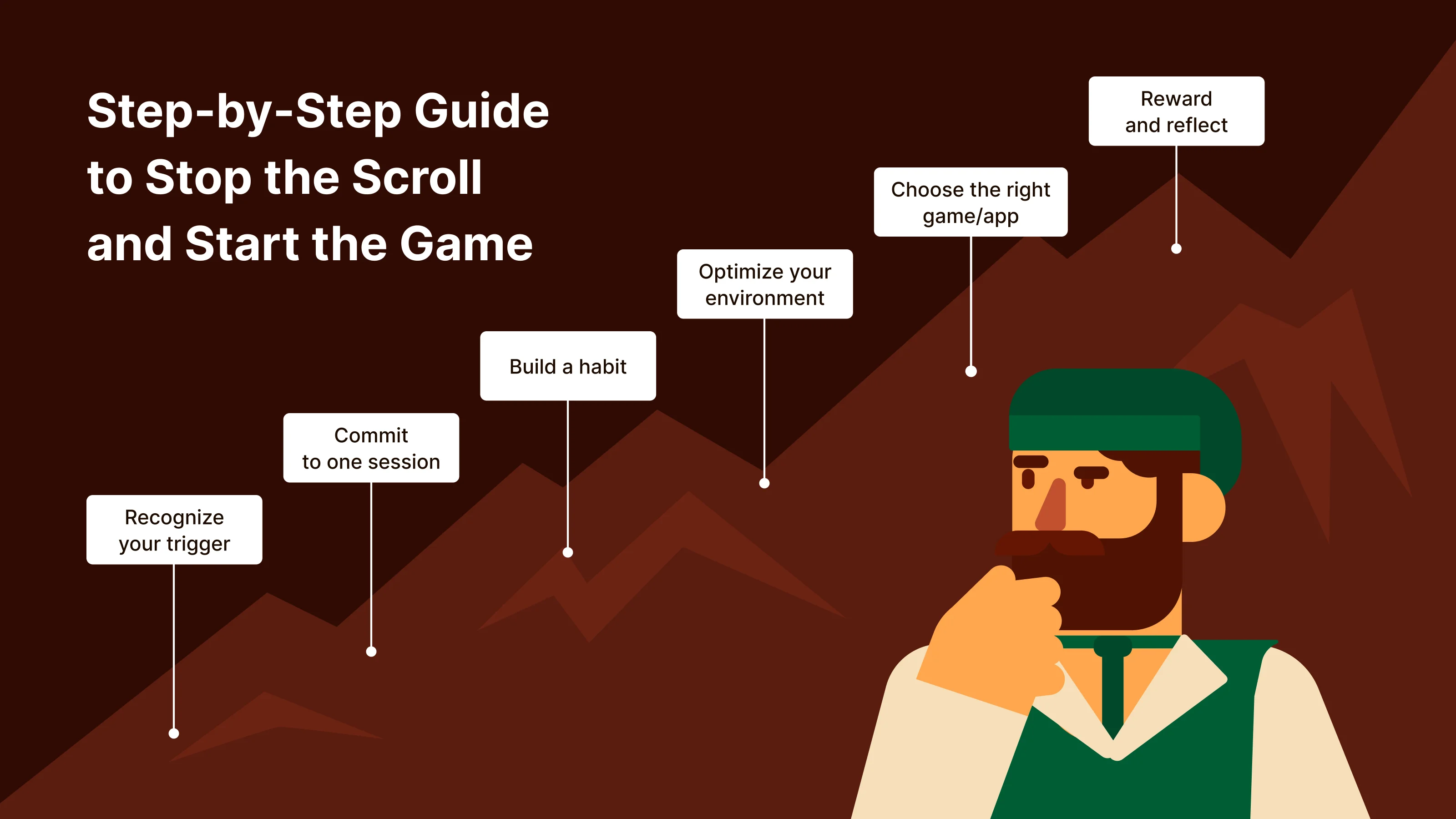
Here's how you can begin to swap your scrolling habit for a geography game habit: 1. Recognize your trigger. Notice when you automatically reach for your phone: waiting for a bus, standing in line, after a notification. 2. Commit to one session. Next time you're about to open your feed, instead open a geography game session for 5 minutes. 3. Build a habit. Set a daily reminder or track a streak: "5 minutes geography game every morning/afternoon." 4. Optimize your environment. Turn off feed notifications, remove social-media apps from your home screen or replace the thumb-scroll shortcut with the game app. 5. Choose the right game/app. Make sure it supports short sessions, offers rounds you can finish, shows measurable progress. Replace scrolling with an addictive geography game like Nibble, for example. 6. Reward and reflect. After your session, reflect briefly: "What new country/flag/geography fact did I learn? How did I improve?" That reinforces the learning habit.
Even tiny shifts add up. Once you try these steps a few times, the quick game session starts to feel more natural than the mindless scroll — and your idle moments become a place for progress instead of drift.
Why Nibble is the best choice for adults who want to swap screen-time habits
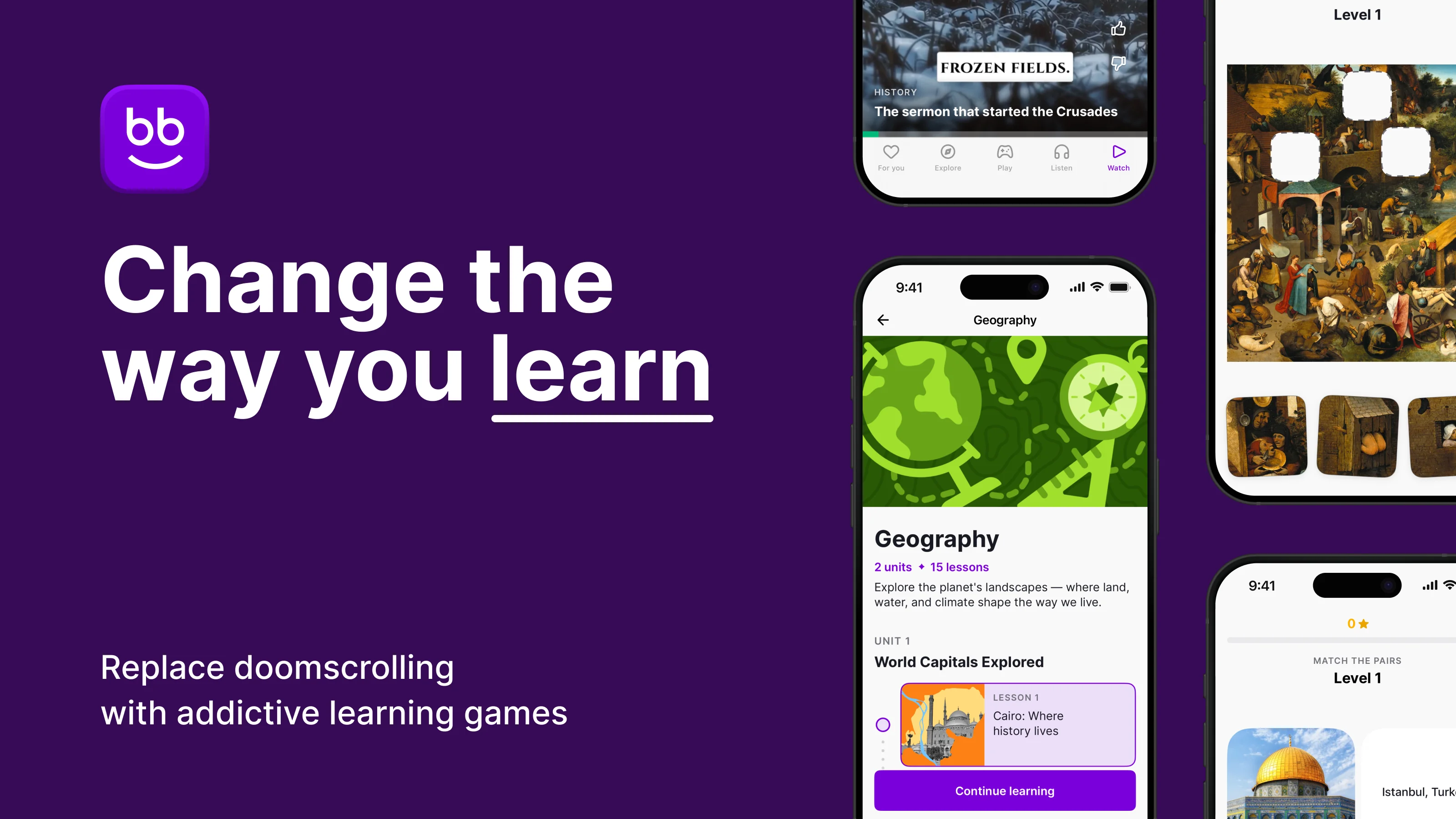
If you're trying to break the endless scroll routine, the alternative needs to be just as easy to open, just as quick to enjoy, and far more satisfying to close. Nibble is built with that exact idea in mind — a learning experience that fits into real adult life without demanding extra time or willpower. When you replace scrolling with addictive geography game sessions inside Nibble, you keep the fun and lose the drain.
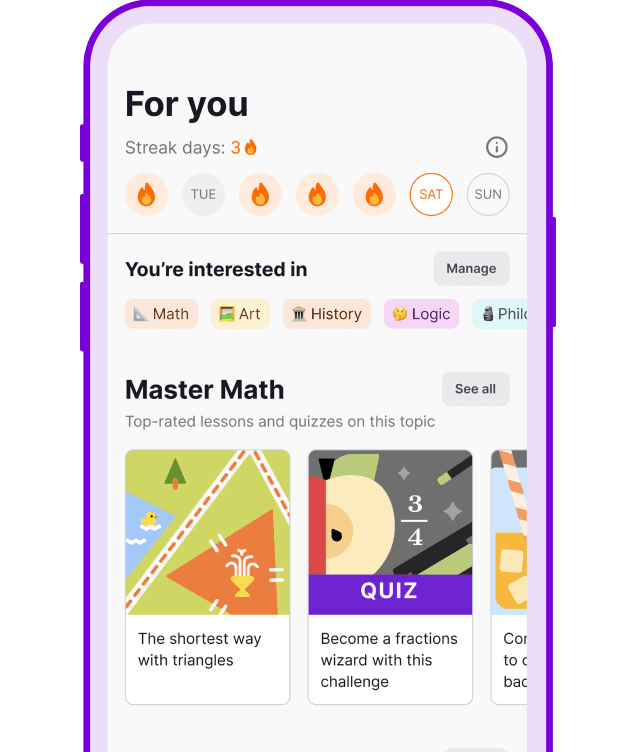
Here's why Nibble stands out: • Bite-size lessons + games: Whether it's matching a flag, identifying a landmark, or answering trivia questions in a fast geography round, every session takes under five minutes. It's a fun way to learn that adapts to your skill level. • Finite sessions: Unlike endless feeds, every Nibble round ends. You play, you finish, you close the app feeling complete, not caught in a loop. • Adult-friendly: No loud animations or kid-style gamification. Everything is built for adults who want quick stimulation, not noise. • Broad learning scope: Geography is just the start. You can also explore history, cinema, logic, biology, personal finance, art, statistics, and more, providing productive alternatives to suit your mood. • Real progress tracking: You see growth as you recognize more flags, locate more countries, and improve your score. Tiny sessions still add up. • Habit-friendly: With optional reminders, streaks, and micro-sessions, you build a routine without feeling pressured or overwhelmed.
So next time you reach for your phone to scroll, use your next idle minute productively — open Nibble instead and turn a habit that drains your attention into one that builds it.
Play Nibble geography game to reclaim your time
Mindless scrolling feels easy in the moment, but over time it chips away at your attention, energy, and the small pockets of free time you could be using more intentionally. A simple switch — replacing a few minutes of scrolling with an addictive geography game habit — gives you structure, enjoyment, and a sense of progress without asking for a big lifestyle shift. Even one short session can turn an idle pause into something that leaves you sharper and more aware of the world. Nibble makes that shift effortless. With under-five-minute flag matches, landmark rounds, and quick trivia sessions, it fits seamlessly into the same moments when you'd normally swipe through a feed. If you want to test it for yourself, download Nibble and try your first 5-minute geography game. See how it feels to gain something from those tiny in-between moments.

Frequently Asked Questions
What if I just like the randomness of scrolling?
Randomness feels enjoyable because your brain is wired to anticipate surprises — it's the dopamine "what's next?" effect. Geography games offer that same sense of unpredictability through new flags, countries, or trivia each round, but they add structure and closure so you don't fall into an endless loop. You still get novelty, just without losing track of time.
How long should I play the geography game?
Even a single 3–5 minute session is enough to start shifting the habit. The goal is consistency, not duration. If you have more time, you can do additional rounds — but the real benefit comes from choosing a defined activity instead of a bottomless feed.
Will I learn anything meaningful or just play?
Yes. Geography games train recognition of flags, capitals, shapes, landmarks, climate cues, and spatial relationships. These micro-moments build a surprisingly rich mental map over time, and studies show game-based geography tools significantly improve recall and motivation.
Can I use this during a commute or while waiting in line?
Absolutely. Short, idle moments are ideal for quick geography rounds. They keep your mind lightly engaged while staying fully mobile — easy to start, easy to stop, and far more intentional than scrolling.
Is it too late to start as an adult?
Not at all. Adults often learn better in focused, bite-sized bursts, which is exactly how geography games work. Micro-learning sessions build up gradually, and research supports game-based learning as effective for all ages, not just students.
Published: Dec 20, 2025


4.7
+80k reviews
We help people grow!
Replace scrolling with Nibbles – 10-min lessons, games, videos & more
More articles from Nibble
Replace Scrolling with an Addictive Geography Game: The Smarter Way to Use Your Phone
You pick up your phone for a minute, but often end up scrolling for 20. Sounds familiar? But what if you could replace scrolling with an addictive geography game that grows your brain instead of numbing it?
Nibble Team
Dec 20, 2025
11 min
Replace Doomscrolling with Biology Microlearning: How to Turn Phone Time into Brain Time
You unlock your phone to check one notification, and suddenly 45 minutes have vanished into endless social media feeds. Your mood has dipped, and you've gained nothing but anxiety from mindless scrolling.
Nibble Team
Dec 21, 2025
12 min

How much is Nibble app? A full breakdown
Many people ask is Nibble app free, does Nibble cost money, and how much does Nibble app cost in total. This guide brings all the details together to help you make an informed decision.
Nibble Team
Dec 22, 2025
10 min