

2 units • 10 lessons
How to Learn Ornithology From Scratch
Most people who get interested in birds start by trying to name every species they see - and quickly hit a wall when a wren vanishes into a hedge before they've confirmed whether it was a wren. The name-first approach turns birdwatching into a quiz you keep failing rather than a subject slowly coming into focus.
Short answer: Start with the basics of field observation - where birds are, how to watch them without disturbing them, and how their behavior shifts across the seasons. Then move to the ecological partnerships that explain why certain birds appear in certain places. One complete pass through the course takes about 40 minutes.
What you need to start learning ornithology
Less than most people think - and considerably less than birdwatching guides would have you believe.
You do not need binoculars or any field kit
The first lesson in this course covers how to observe birds without disturbing them, which is something you can do with your own eyes at a window, a kitchen table, or a park bench. Binoculars help eventually. Nothing in these lessons requires them. Birdwatching is one of the most interesting hobbies you can pick up without buying anything first.
You do not need a science background
Ornithology has roots in biology, ecology, and evolutionary science - but the Nibble course starts from zero. No terminology is assumed before your first lesson. The words that come up are explained as they arrive.
You do not need a special location
From backyard sparrows to garden goldfinches to species found only in North America, Europe, or Australia, the course draws on birds across many habitats and regions. Whatever outdoor space you have access to - a park, a garden, a window - is enough to begin.
The order to learn ornithology in
Stage 1 - Start with Birdwatching
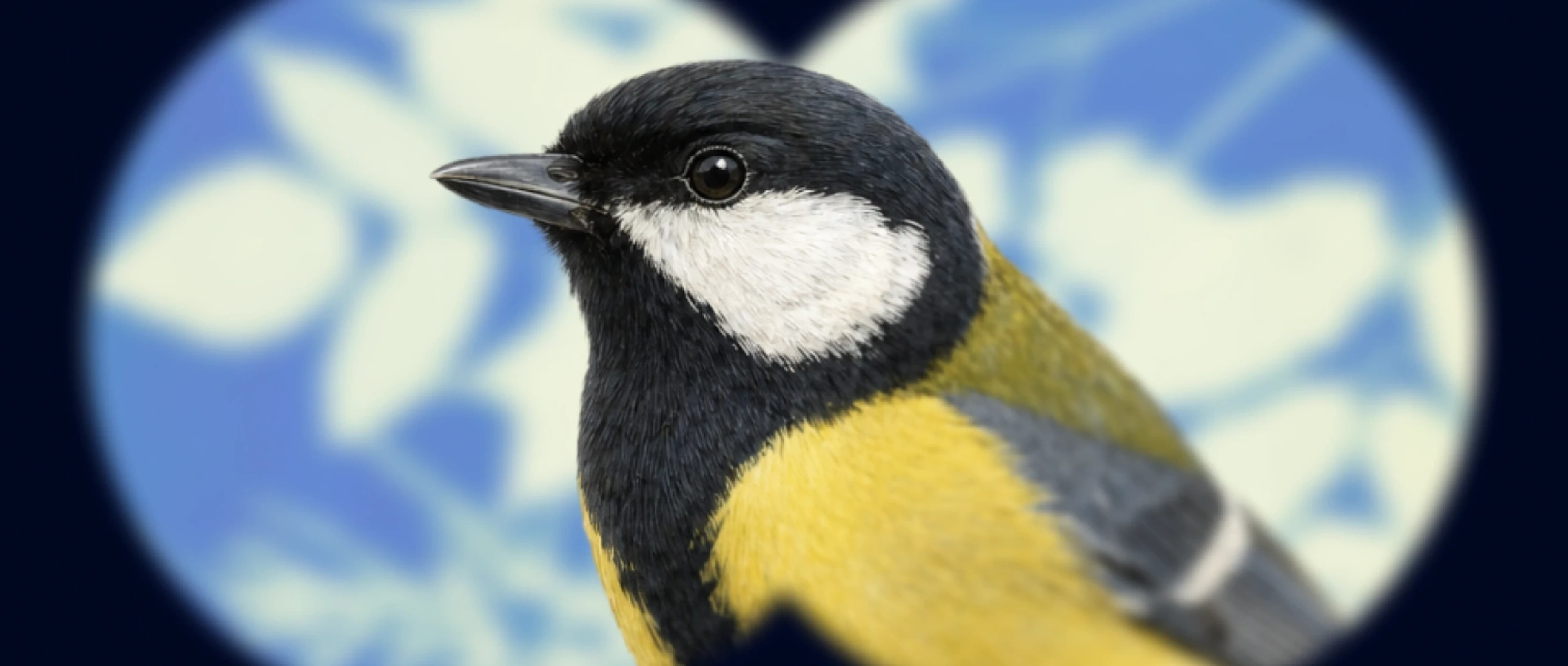
The Birdwatching unit is where the course begins, and its position at the front is earned. The lessons lay down the ground rules: where to look, how to watch without disturbing what you're watching, and how to plan a trip to a new birding spot. They also cover how bird behavior shifts across the seasons - from nesting in spring through autumn departure to the first spring arrivals - and what makes certain corners of the world produce birds found nowhere else on Earth. Without this foundation, the partnerships in Stage 2 are just interesting stories. With it, they're explainable. The goal here is pattern recognition, not species identification.
Stage 2 - Move on to Birds That Need Our Gardens
Birds That Need Our Gardens takes the observation habits from Stage 1 and grounds them in something specific: the relationships between birds and the plants they depend on. A rose-pink bullfinch and a rowan tree loaded with bright berries. A blackcap warbler wintering in a British garden when fifty years ago it would have been in Africa. A goldfinch whose narrow bill is a near-perfect fit for the packed seed head of a sunflower. These aren't coincidences. They're systems that have been evolving for millions of years, and recognizing them is what turns a casual bird sighting into something much harder to forget.
This unit rewards revisiting once you've spent time watching a garden or planted area in person. The more you've actually observed, the more these stories land.

Common questions
What does ornithology mean?

Ornithology is the scientific study of birds - it’s the branch of zoology devoted to them. The word comes from the Greek ornis/ornithos (“bird”) plus logos (“study”). It covers everything about birds: their anatomy and physiology, behavior, song, migration, ecology, evolution, classification, distribution, and conservation. One thing that sets it apart from most sciences is how much real data comes from amateurs - hobbyist observers have contributed to the field for well over a century, and still do.
What is birding vs birdwatching?
Both mean observing wild birds for pleasure, and plenty of people use the two words interchangeably. The difference is mostly one of intensity and self-identification:
Birdwatching tends to suggest the more casual, relaxed version - enjoying birds from a window, a feeder, or a walk, appreciating them without much pressure to identify or record everything.
Birding usually implies a more active, skill-driven pursuit - deliberately seeking birds out, identifying them by sight and sound, keeping lists (like a “life list” of every species seen), and sometimes traveling specifically to find certain birds.
The boundary is genuinely fuzzy. Many dedicated hobbyists call themselves “birders” partly to signal that seriousness. And note that neither term is the same as ornithology: birding and birdwatching are hobbies, while ornithology is the scientific discipline - though keen birders often feed data into real ornithological research.
Best way to start getting into ornithology?
The easiest on-ramp is to start as a birder and build from there:
Start local and small. Learn to recognize the dozen or so common birds around your home or nearby park before worrying about rarer species. Familiarity builds fast once you focus on your own patch.
Get binoculars. A pair around 8x42 is the standard beginner recommendation - good magnification without being hard to hold steady.
Use free apps. Merlin Bird ID (from the Cornell Lab of Ornithology) identifies birds from a photo or even their song; eBird lets you log sightings and see what’s been spotted near you. A regional field guide (book) is also worth having.
Learn the sounds. You’ll hear far more birds than you see, so training your ear is the single biggest skill jump. Merlin’s sound ID helps you practice.
Find other people. A local bird club, nature reserve walk, or Audubon-style chapter will teach you more in a few outings than months alone.
Contribute to citizen science. Logging sightings in eBird or joining counts like the Christmas Bird Count is the real bridge from hobby into actual ornithology - your observations become usable data.
Does Nibble offer a certificate for completing the Ornithology course?
No. Nibble doesn't offer certificates or accreditation for its courses, ornithology included. The course is designed for curious adults who want to understand birds and the natural world, not for formal assessment. There's nothing to pass or fail - just a subject that rewards the time you give it.
Is Nibble a good app?
Based on thousands of Nibble reviews across the App Store and Google Play, users often highlight the short lessons, variety of topics, and the option to learn instead of scrolling.
- 4.3
App Store 46K+ reviews in US
- 4.4
Google Play 128K+ ratings worldwide
- 10M+
Downloads worldwide across platforms
- 670+
Content pieces. New lessons weekly


Google Play
I feel it makes one think about things that you would definitely not think of doing in your everyday life. Always look at the bigger picture and try and fathom how to get out of a difficult situation. Think outside of the box.

Karen Slaughter
July 21, 2026

AppStore
Very informative — I really like Nibble. If you want to expand your knowledge I highly recommence nibble. It doesn’t cost that much either. Very affordable. It has many options on what to learn about.
Goddaughter81
Jun 13, 2026
Google Play
More fun than games — This gives me more satisfaction than any of my games, because it means something. I’m still going to play my word solitaire and word connect, but nibble is def in the rotation.
OK88s
Jun 10, 2026