
Physics
Aeronautics: How Planes, Helicopters and Airships Fly
By the end of this unit you'll be able to explain why a loaded airliner stays up, how a helicopter hangs in one spotб and why an airship floats at all. The first lesson is free, no card needed, and there's nothing to buy or set up.
How to understand how aircraft fly
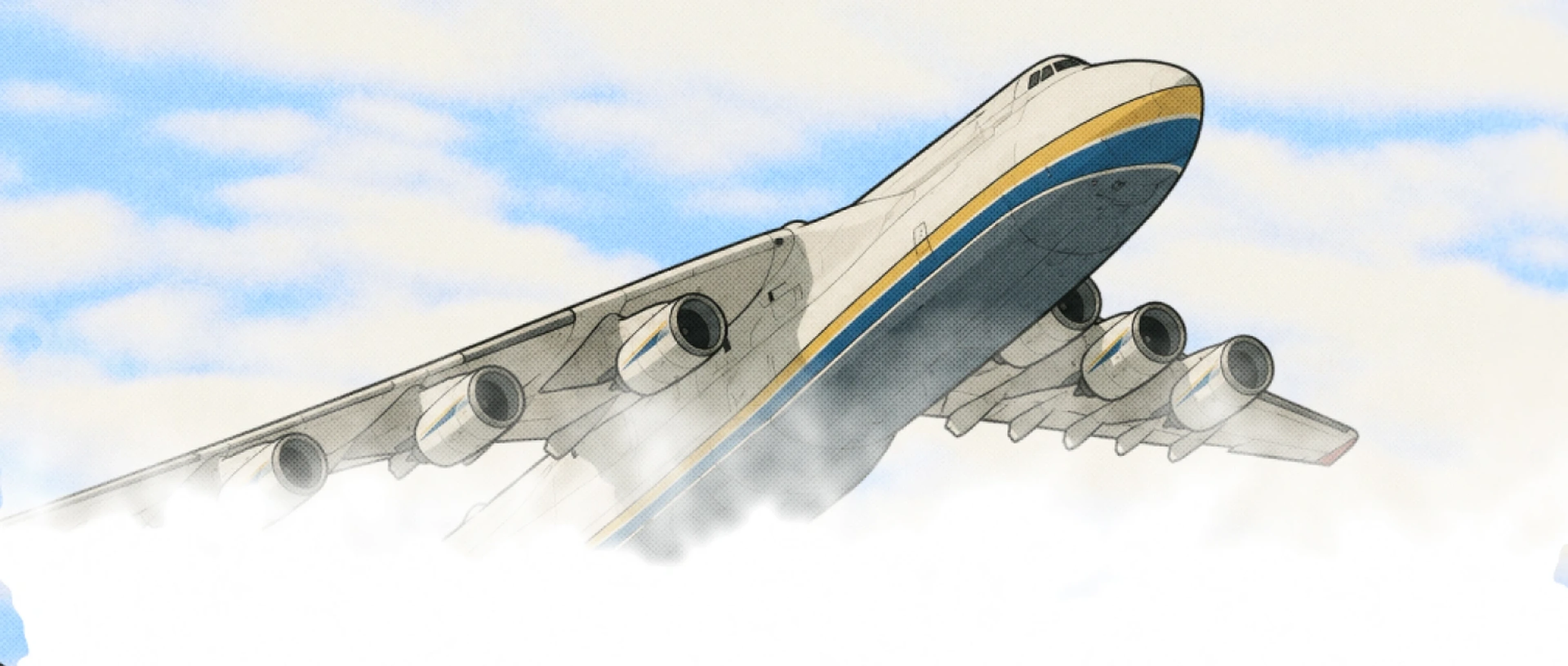
Staying in the air comes down to one problem. Gravity pulls an aircraft down, so something has to push it up with at least as much force. What changes from one flying machine to the next is where that push comes from: a plane gets it from wings moving through air, a helicopter from wings that spin, and an airship from skipping wings altogether.
Here's what makes it click. A wing keeps pushing air downward, and the air pushes back up on the wing. Once you see flight as a trade with the air around the aircraft, the three kinds stop looking like three separate mysteries.
The usual wrong turn is giving the engines too much credit. In a plane, engines drive it forward, and the wings do the lifting. Weight is the other half of that story, so how gravity works makes a good side read before or after the lessons.
How to understand why heavy aircraft stay up
A loaded airliner is a very heavy object that sits steadily at cruising height, which is why it feels like a trick. It isn't one. The science of flying heavy is the lesson aimed at exactly that puzzle.
How to understand hovering and floating
Two other aircraft break the habit of moving forward to stay up. A helicopter can hang in one spot, which an ordinary airplane can't, and The science of flying without moving forward is where that gets its own lesson. Airships go further. The science of the aircraft that is lighter-than-air deals with craft that float, and the idea underneath is simple: they push aside air that weighs as much as they do or more, much as a boat does with water.
Where to start with the science of flight
Start with flying heavy. The other two lesson titles are named against that baseline. Flying without moving forward assumes you know why most aircraft have to keep moving, and lighter-than-air assumes you know what heavier-than-air is up against.
Nothing here needs a purchase or any equipment, so you can begin the moment you pick a lesson. If you'd rather start by flying through a story, the Myth of Icarus offers a fair reminder that people wanted to fly long before anyone understood how.
Where the science of flight fits in learning physics
Flight is physics you can watch from a window. Within learning physics, nothing in these lesson titles points to another unit you'd need first so that you can come to it before the experiments side or after. When the three lessons feel solid, a round of science trivia is a quick way to see what stuck.



Is Nibble a good app?
Based on thousands of Nibble reviews across the App Store and Google Play, users often highlight the short lessons, variety of topics, and the option to learn instead of scrolling.
- 4.3
App Store 46K+ reviews in US
- 4.4
Google Play 128K+ ratings worldwide
- 10M+
Downloads worldwide across platforms
- 670+
Content pieces. New lessons weekly


Google Play
I feel it makes one think about things that you would definitely not think of doing in your everyday life. Always look at the bigger picture and try and fathom how to get out of a difficult situation. Think outside of the box.

Karen Slaughter
July 21, 2026

AppStore
Very informative — I really like Nibble. If you want to expand your knowledge I highly recommence nibble. It doesn’t cost that much either. Very affordable. It has many options on what to learn about.
Goddaughter81
Jun 13, 2026
Google Play
More fun than games — This gives me more satisfaction than any of my games, because it means something. I’m still going to play my word solitaire and word connect, but nibble is def in the rotation.
OK88s
Jun 10, 2026
Common questions
Do scientists know how planes stay in the air?

Yes. The physics of lift is well understood, and engineers calculate it every time they design a wing. The confusion comes from popular shortcuts. Wings push air downward, and the air pressure above and below a wing differs; these are two ways of describing the same thing, not rival theories.
Can an airplane stay at one place in the air?
Not an ordinary one. A standard airplane's wings only make lift while air flows past them, so it has to keep moving forward. Helicopters get around that by spinning their wings (rotor blades) instead, and airships and balloons float in place because the air they push aside weighs as much as they do.
Which aircraft is considered lighter-than-air?
Balloons, blimps, and airships. They rise because the gas or hot air inside them is lighter than the air around them, so they need no wings. Airplanes and helicopters are the opposite, heavier than air, and have to produce lift to stay up.