
Physics
Experiments: How to understand famous physics experiments
After this unit, you'll know what Newton actually proved when he split sunlight with a prism, and why Schrödinger invented a cat that's both alive and dead just to make a point about quantum physics. Two experiments, one you can watch with your own eyes and one you can only reason through.
How to understand famous physics experiments
Physics experiments split into two rough camps: things people actually built and ran, and things physicists only worked out on paper because building the real version was impossible. This unit has one of each: a prism you could set up on a windowsill and a cat you could never actually put in a box. Both are still among the first examples people reach for when they try to explain what physics actually does.
Newton's prism and the colors hiding in white light
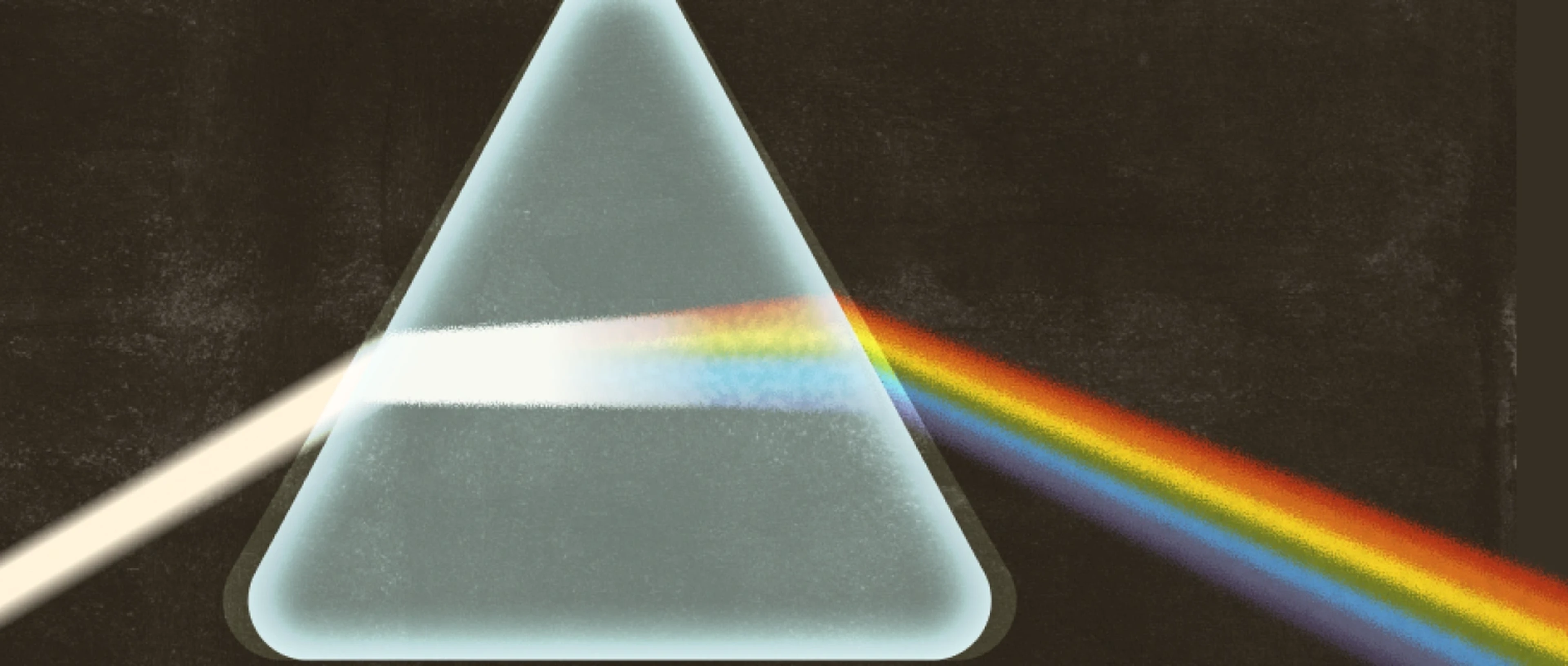
Isaac Newton didn't invent the rainbow, but he did prove where it was hiding. By passing sunlight through a glass prism, he showed that ordinary white light is actually a mix of colors, something the prism reveals rather than creates; a second prism could then recombine those colors back into white light, which is the detail that convinced skeptics. The lesson Unlocking white light with Newton's prism walks through exactly how that works. Newton is just as well known for working out how gravity actually works, so the prism was only one piece of what made him famous.
Schrödinger's cat and why it isn't a real experiment
Schrödinger's cat isn't an experiment anyone ran, and that's the part people usually get backward. Erwin Schrödinger invented the scenario - a cat sealed in a box with a trigger that's either radioactive or not - to criticize an idea in quantum mechanics, not to confirm one. According to the math, the cat is technically both alive and dead until someone opens the box and looks, an absurdity Schrödinger was deliberately pointing out, not endorsing. The lesson The quantum paradox of Schrödinger's cat unpacks why that absurdity was the whole point, and why it still unsettles the atom-as-solid-ball picture from Dalton's early atomic model.
Where to start with physics experiments
Neither lesson needs the other, so start wherever your curiosity points, toward something you can watch happen or something you can only reason through. Both lean on the same older habit of testing an idea against reality or, when that's not possible, against pure logic, and who actually invented science traces where that habit began.
Where physics experiments fit in learning physics
Experiments is currently the only unit under Physics on Nibble, so there's no sequence of sibling units to place it before or after; it's the whole collection so far, pairing a classical result you can picture with a quantum one you mostly have to trust. For the wider picture of how to learn physics, the topic hub is where that starts. From there, physics stretches well past light and quantum paradoxes into territory like why space looks solid black and how magnetic field lines work.





Is Nibble a good app?
Based on thousands of Nibble reviews across the App Store and Google Play, users often highlight the short lessons, variety of topics, and the option to learn instead of scrolling.
- 4.3
App Store 46K+ reviews in US
- 4.4
Google Play 128K+ ratings worldwide
- 10M+
Downloads worldwide across platforms
- 670+
Content pieces. New lessons weekly


Google Play
I feel it makes one think about things that you would definitely not think of doing in your everyday life. Always look at the bigger picture and try and fathom how to get out of a difficult situation. Think outside of the box.

Karen Slaughter
July 21, 2026

AppStore
Very informative — I really like Nibble. If you want to expand your knowledge I highly recommence nibble. It doesn’t cost that much either. Very affordable. It has many options on what to learn about.
Goddaughter81
Jun 13, 2026
Google Play
More fun than games — This gives me more satisfaction than any of my games, because it means something. I’m still going to play my word solitaire and word connect, but nibble is def in the rotation.
OK88s
Jun 10, 2026
Common questions
What is the most famous experiment in physics?

Newton's prism experiment and Schrödinger's cat are both regularly named among the most famous, though physicists disagree on which one deserves the top spot. One split light into visible color to prove something concrete; the other was never physically performed and still reshaped how people think about reality.
Why are experiments important in physics?
Because a theory that sounds right isn't the same as a theory that's right; experiments are how physics checks its own ideas against reality, and when reality disagrees, as it did with the atomic model and the Copenhagen interpretation alike, the theory has to change, not the result.
Why do physicists use thought experiments?
Because some situations can't be built in a lab, only reasoned through. A thought experiment lets a physicist push a theory to an extreme, like sealing a cat in a box with a radioactive trigger, and see whether the logic holds up or quietly falls apart somewhere along the way.